We watch how industries change and research the technology the field needs.

Since 2016, SyncTechno has turned technology shifts seen in international standardization and the needs of real projects into research topics in unmanned vehicles, maritime and vessels, public safety and emergency response, and IoT standards and testing, developing them through joint research and field trials with public agencies, research institutes and universities into technology used in our products and services.

01Finding opportunity in change

We follow changes in international standards and industry ecosystems to identify new service and technology requirements early.

02Validating through research and demonstration

We implement the required technology based on real operating environments and field data, and validate both its applicability and its operability.

03Carrying results into products and services

We apply validated research results to the DX product line and our implementation services so that technology leads to real change in operations.

Core research areas

We pursue the research topics built up through standards activities and project delivery in four areas: unmanned vehicles, maritime and vessels, public safety and emergency response, and IoT standards and testing.

01

Unmanned Vehicles

In unmanned vehicles, as Physical AI extends into the field operation of drones, we are developing a ground control system (GCS) and onboard software for the aircraft. In addition to multi-aircraft control and mission planning, the GCS handles Sim-to-Real in a single environment: AI models tested in simulation are applied to real aircraft.

On the companion computer that acts as the brain of the drone runs DX-Sky Drone (onboard software), which handles communications, video, flight recording and onboard AI inference. We carry what we have learned from commissioned projects for the Korea Land and Geospatial Informatics Corporation, the Korea Aerospace Research Institute and the Korea National Park Service into both software products and keep improving them.
Research FocusGround control system (GCS)Drone onboard softwareSim-to-Real testing and model deployment
02

Maritime and Vessels

In the maritime and vessel field, we have researched technologies that extend land-based mobile communications to the sea and reduce the information gap between ships and shore. Through 3GPP standardization and R&D, we have examined the maritime application of LTE and 5G and the requirements for long-range communications, and have laid the communications and data foundation for autonomous vessels and smart maritime services.

We currently collect LTE, VSAT and VDES link status together with vessel information on operating ships and analyze changes in communication quality during voyages, including LTE signal quality and VSAT SNR and loss rate. Using the accumulated data, we are comparing and validating route selection policies for multiple networks that consider latency, loss, available capacity and service priority, and continue to expand the scope of this research.

Research FocusMaritime mobile communicationsOnboard communication quality analysisMulti-network route selectionShip-to-shore data integration
03

Public Safety and Emergency Response

In public safety and emergency response, we have researched multilingual delivery methods so that foreign residents in Korea and Korean nationals abroad receive emergency information in time, and have proposed accessibility technologies that allow alerts to be received regardless of disability or device environment. More recently, we have extended our research to technologies that use CAP and IoT to turn emergency information into automated facility responses and individual risk notifications.

We research and validate the technologies that turn emergency information into real response, including foreign-language support and message length limits for emergency alerts, validation and filtering of CAP-based alerts, suppression of unnecessary actions caused by repeated alerts, integration with IoT and automation environments, and mobile alerts that take user location and risk level into account.

Research FocusPublic warning reliabilityIoT and automated facility responseLocation-based personal alerts
04

IoT Standards and Testing

In IoT standards and testing, IoT has been one of our core research areas since our founding in 2013. Centered on oneM2M, we research technologies that verify the interoperability of IoT platforms and devices and the standards conformance of products, and we have built development environments in which data exchange and standards conformance between devices and platforms can be checked during development.

Our experience in oneM2M standardization and GCF testing and certification led to CertMate. CertMate has been applied to the accredited oneM2M test environment of the Telecommunications Technology Association (TTA), the test environment for the smart city open data hub of the Korea Electronics Technology Institute (KETI), and the e-IoT platform profile validation environment of the Korea Electric Power Research Institute. Our research focuses on turning the requirements of standards documents into test environments that can be used in actual product validation and certification procedures.

Research FocusoneM2M interoperabilityStandards conformance testingTest and certification environments

We carry research results into publications, presentations and joint research.

Recent publications, presentations and joint research that show the topics and results of SyncTechno's research.

At the seventh IALA DTEC meeting, the IMT-2030 task group led by CEO Hyounhee Koo finished drafting a Recommendation and a Guideline on using 6G technologies for Marine Aids to Navigation.

CEO Hyounhee Koo and Director Changho Ryoo, with Professor Jaeseung Song of Sejong University, analyzed 606,625 communication records from 12 voyages of a container ship to examine how well cellular and geostationary satellite links fill each other's gaps at sea.

Read the paper

At the 56th meeting of the 3GPP Project Coordination Group (PCG), CEO Hyounhee Koo presented IALA's role and recent activities on behalf of IALA.

The presentations proposed ways to use mobile communications technology for public safety communications and to apply 3GPP standard features to maritime use cases.

View All Standards and R&D News

Industry-academic-research collaboration deepens our research.

We broaden our research ecosystem by working with domestic academic societies, standards committees and forums.
Through industry-academic collaboration with Seoul National University, Yonsei University, Korea University, Gachon University and others, we have jointly researched next-generation communications technologies such as cognitive-augmented meta-communications and coverage extension using autonomous mobility.

Through industry-academic collaboration and public sector projects, we conduct research in next-generation communications and autonomous mobility, and connect different areas of expertise to validate the applicability of new technologies.

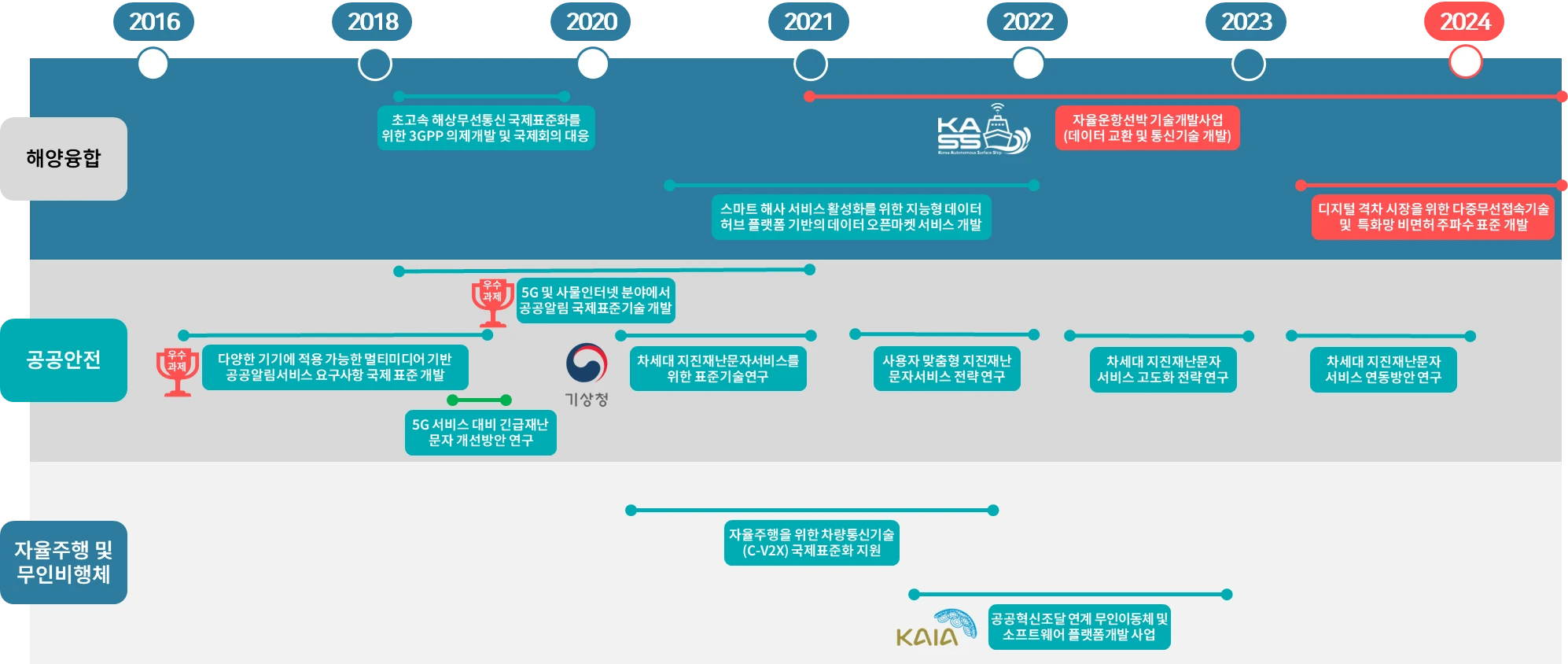
SyncTechno R&D history

We connect research results with products and implementation services.

Our R&D results are applied to products and implementation services, becoming technology that solves real problems in the field.

Public Safety and Emergency Response
IoT Standards and Testing
Emerging Research Areas

Extending our research capabilities into new fields

Building on our experience in unmanned vehicles, maritime and vessels, public safety and emergency response, and IoT standards and testing, we are researching next-generation radio and the space environment. We continue our work and presentations on spectrum use for space environment observation and radio and electromagnetics while exploring how new technologies can be applied.