

DX-Safety

DX-Safety combines the Public Warning Center (PWC), which turns CAP alerts from agencies into automated facility responses,
with Alerti, an app that delivers disaster information and action guidance for the user's location.

One source of emergency information, delivered to both on-site response and personal safety

DX-Safety provides two paths that turn emergency information into real action. PWC validates public warnings issued by authorities and connects them to automated responses in facilities and IoT environments, while Alerti delivers earthquake and tsunami information to mobile devices based on each user's location and potential impact.

Organization and facility response

Public Warning Center (PWC)

Filters out only the alerts that require action and connects them to guidance and equipment control suited to on-site conditions.

Personal mobile response

Alerti

Provides relevant alerts based on the user's location and disaster information, and supports checking maps, details and protective actions as well as recording one's safety status.

Authority-issued alerts turned into information on-site equipment can understand and act on

01Public warning reception and processing

Selects the information needed for on-site response from CAP alerts issued by the Korea Meteorological Administration and other authorities, and distinguishes alert states such as new, updated and cancelled.

02Delivery to IoT environments

Delivers alerts to oneM2M-based platforms and existing IoT and automation environments so that different devices and services can use the same emergency information.

03Automated response by facility

Can be extended to response scenarios suited to each site, including doors, gas valves, circuit breakers, public address announcements, elevators, production equipment and UAVs.

04Target areas and response policies

Impact areas can be defined as polygons as well as circles, and alert notifications, response actions and priorities based on the importance of facilities and devices can be configured per device according to site policy.

Beyond forwarding alerts, deciding the response needed now

PWC receives CAP-based emergency alerts, verifies that each alert is valid and evaluates alert status and history together so that equipment does not operate repeatedly for the same event. When the actual risk increases, it responds again, and it can apply different actions to each facility based on location and expected seismic intensity by region.

Once an alert passes these checks, it is connected to voice guidance and on-site automation such as doors, gas valves and circuit breakers, and delivery and equipment status responses are confirmed. Operational resilience is also built in: even if communications or systems become temporarily unstable during a disaster, alert history and unprocessed information are preserved so that processing can resume after recovery.

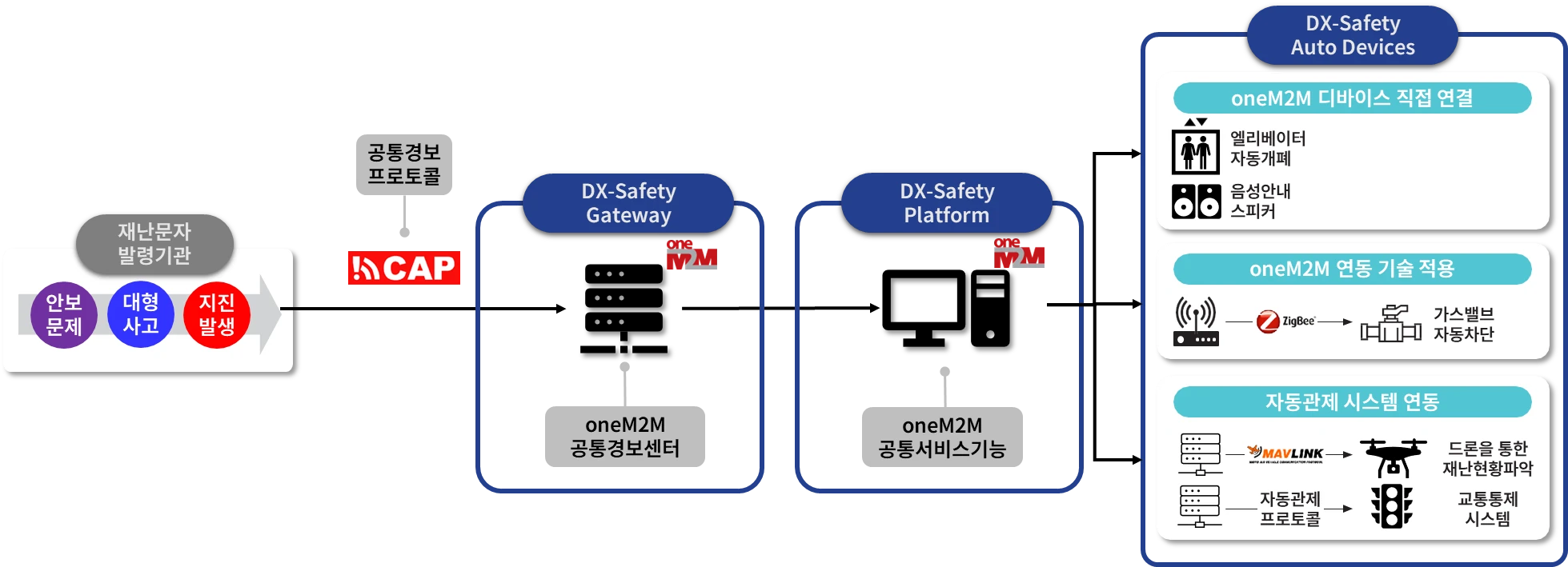
DX-Safety architecture connecting public warnings to automated facility and IoT responses
1

Alert assessment

Alert validation and status

Test and exercise alerts, along with expired or outdated alerts, are excluded from equipment control. New, update and cancel messages are processed by status.

Duplicate alert control

Follow-up alerts for the same earthquake do not trigger equipment again. If the magnitude or risk level rises, the system checks alert history and risk level and responds again.

Facility-specific response criteria

Response criteria can be set by combining facility location, distance from the epicenter, alert level and expected seismic intensity by region, with priority on the areas and facilities most affected.

2

On-site response

Integration with existing systems

Works with oneM2M devices as well as other IoT devices and existing automation systems. Public alert-based automated response can be extended without replacing equipment.

Voice guidance and shelter information

Announces the situation by voice and provides nearby shelter information. Alongside equipment control, it can guide people on site to the actions they need to take right away.

Configurable actions on cancellation

For some equipment, such as gas valves, automatic restoration can itself be hazardous. Follow-up actions after a cancellation alert can be set per device according to site safety policy.

3

Operations and security

Logs and failure recovery

Records alert processing history and device status responses. Unprocessed alerts are retried and recovered after temporary communication failures or restarts.

Access control and encryption

Access permissions for alert input and administrator functions and the range of allowed device connections are configurable, and communication can be encrypted. The design reflects the security requirements of public safety services.

14 scenarios tested in a real automation environment

We connected the Public Warning Center (PWC), a message broker and an automation environment and tested not only normal earthquake alerts but also repeated alerts for the same earthquake, risk escalation, cancellation, test, exercise and expired alerts, malformed messages and security errors. After each alert was delivered, equipment status responses and processing history were also verified.

Suppressing repeated actionsVerified that follow-up alerts for the same earthquake do not trigger equipment unnecessarily

Responding to risk escalationVerified that required actions run again when the risk of the same event increases

Blocking invalid alertsVerified that test, exercise, expired and abnormal messages do not lead to equipment actions

Confirming delivery and actionsVerified that operators can trace each alert from issuance to equipment status response

Emergency information for your location, and what to do next

Alerti brings together earthquake and tsunami information from the Korea Meteorological Administration as well as Taiwan, Japan and the Pacific region, and delivers the alerts each user needs to mobile based on their location and likely impact. After an alert arrives, users can review the situation on the map and in the details, check protective actions for the type of disaster, or record their own safety status.

Integrated domestic and international earthquake and tsunami informationBrings together observations from the Korea Meteorological Administration and from Taiwan, Japan and the Pacific region for a broader view of the situation.

Location-based alertsDelivers alerts to the users who need them, based on their current location and the impact of the disaster.

Maps and details that make the situation easy to understandShows location, magnitude, distance, time and impact information together.

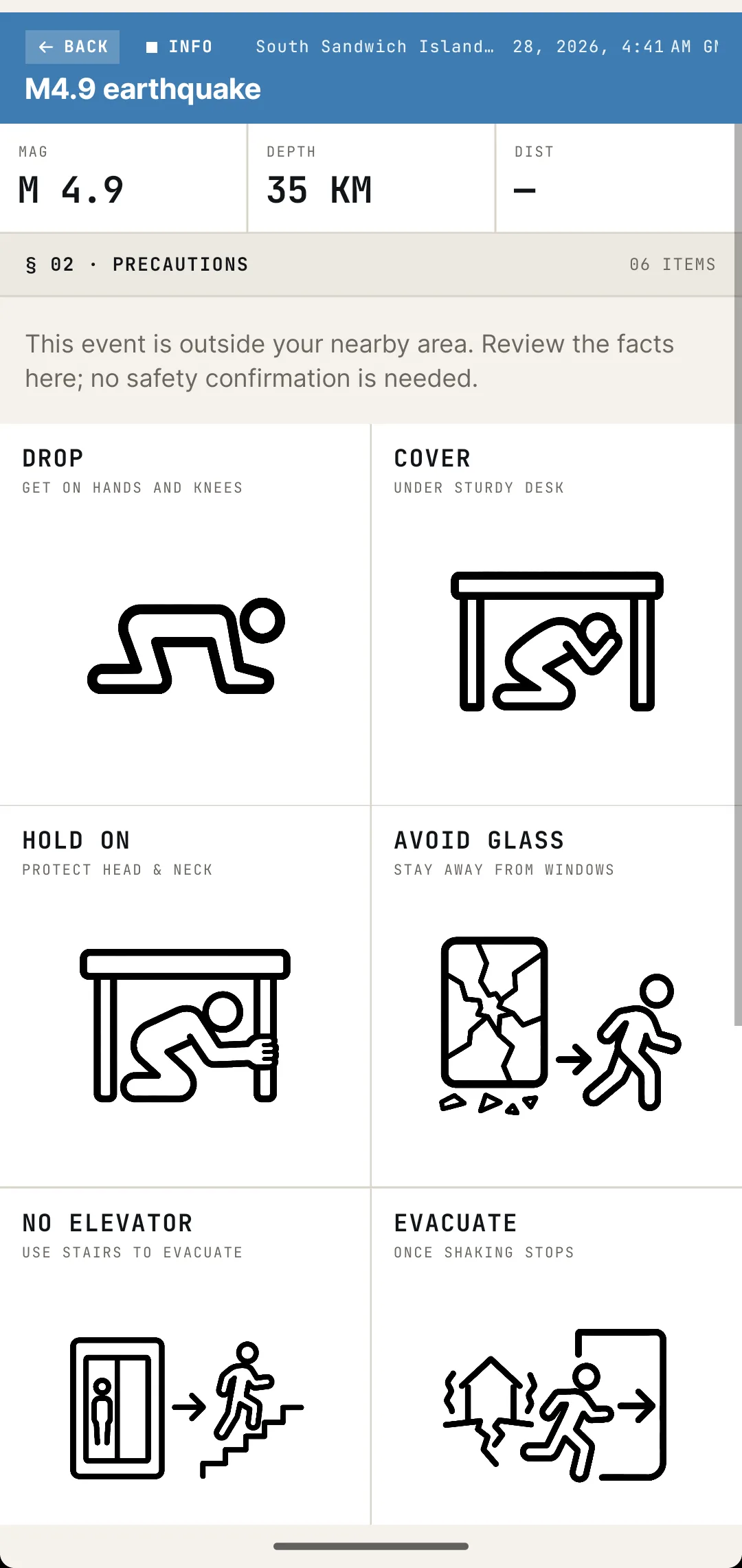
Protective actions by disaster typeIllustrated procedures for earthquakes and tsunamis help users quickly see what to do next.

I’m Safestatus recordingAfter a disaster, users can record their own safety status in the app.

7 languagesAvailable in Korean, English, Japanese, Thai, Vietnamese, Indonesian and Filipino.

How Alerti works, step by step.

One flow from the moment an alert arrives to understanding, action and safety confirmation

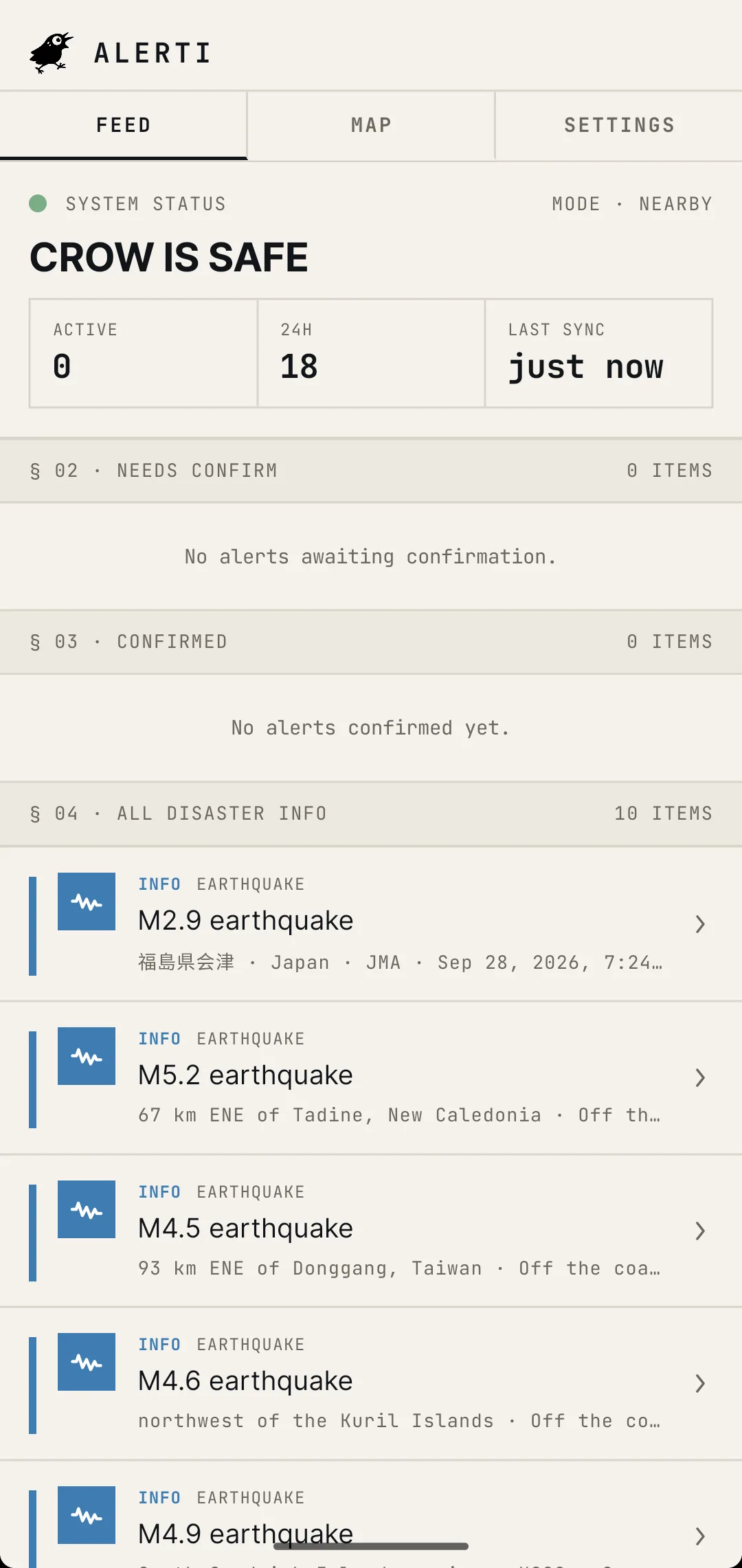
Alerti disaster feed screen
Disaster feedScan earthquakes and tsunamis nearby and worldwide.
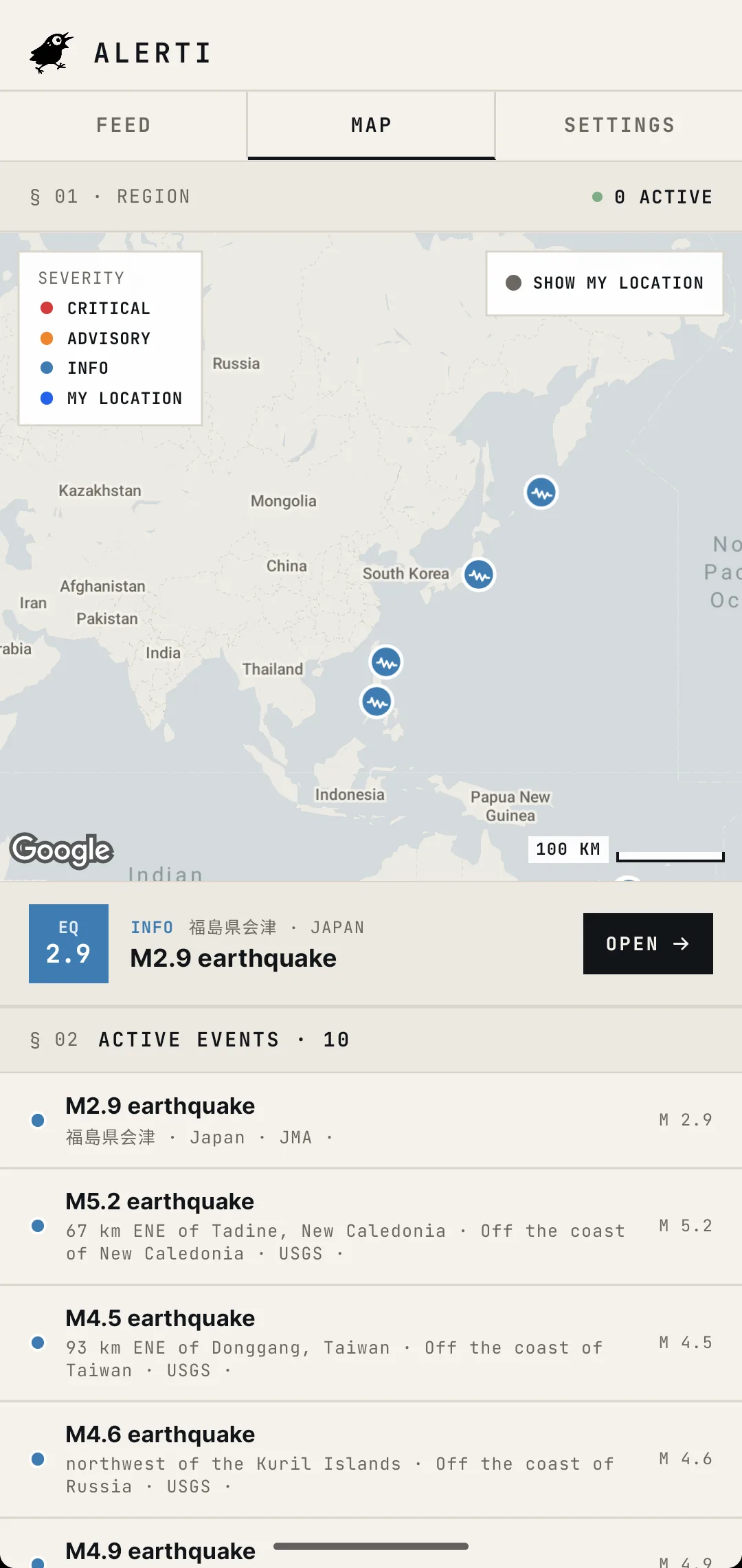
Alerti map screen
MapSee the epicenter and your own location together on the map.
01 / Understanding the situation

When a push notification arrives, users first check the risks around them

Tapping the notification opens the app, where users can see the disaster location and surrounding conditions on a map relative to their current location, then review magnitude, distance, time of occurrence and impact information on the detail screen. Rather than simply delivering an alert, the app presents information step by step so users can understand the current situation.
02 / Judgement, action and safety

Once the situation is clear, users move straight to what to do next and record their safety status

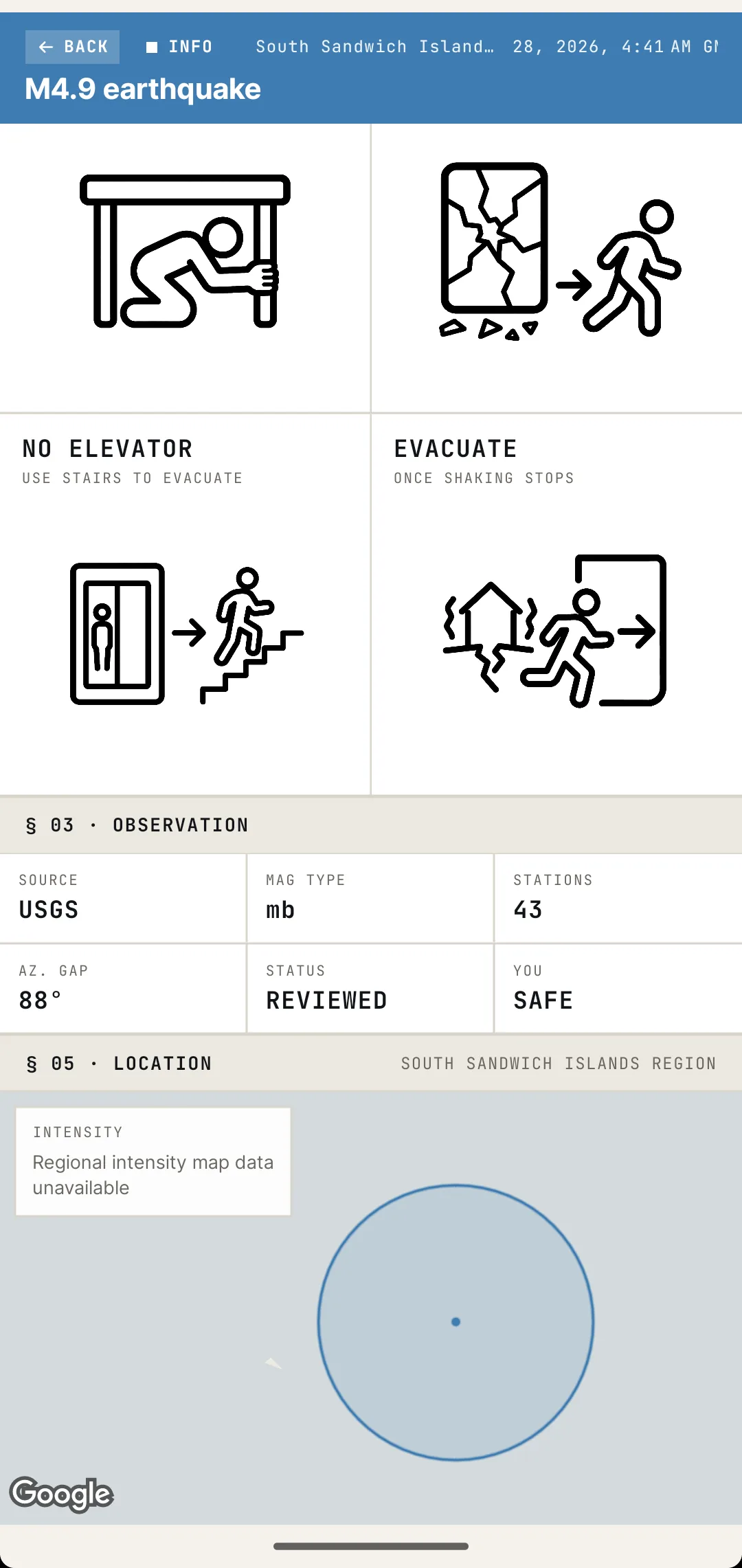
The detail view shows magnitude, depth, distance and observation data, and protective actions suited to earthquakes and tsunamis follow as illustrated steps. Once the event has passed, users record their own safety status with the I’m Safe feature. The screens are ordered the way users actually move, from the moment an alert arrives through understanding, response and safety confirmation.

Alerti protective actions screen
Protective actionsFollow the response steps with illustrations.
Alerti disaster detail screen
Disaster detailsCheck magnitude, depth, distance and observation data.

New emergency response systems built on international standards and existing automation

01CAP-based public warning processing

Distinguishes new, updated and cancelled states of public warnings issued by authorities, selects the information needed for response and delivers it in a form that facilities and services can use.

02oneM2M-based device and data integration

Uses oneM2M common functions such as device management, subscription and notification, location information, access control and data interoperability to connect different IoT devices and services in a single response flow.

03Integration with existing automation systems

Integrates with the automation environments of existing buildings and facilities, extending emergency response functions to equipment already in operation, such as doors, gas valves, circuit breakers, public address systems, elevators and production equipment.

04Alert policies and response actions configured per site

Site-specific policies can define which alerts to receive and which actions to execute based on alert type, risk level, facility location, expected seismic intensity, target area and device status.

05Operation history, security and failure recovery

Records alert processing history and equipment responses, applies access control and encrypted communications, and continues processing unprocessed alerts after temporary communication failures or system restarts.

Automated response for organizations, actionable information for individuals

01From delivery to response

We design the service flow so that emergency information does not stay inside the system but leads to facility actions and individual responses.

02Selective response suited to each environment

The appropriate level of response can be applied where it is needed, considering alert status, risk level, facility location and expected seismic intensity by region.

03Results that operators can verify

Alert processing, delivery and equipment status responses are recorded so that operators can confirm whether a response actually took place.

04Standards experience turned into real services

Building on our experience in CAP and oneM2M public warning standardization, we are extending the scope of application to authorities, businesses, IoT environments and mobile services.

Beyond receiving alerts, connecting them to on-site action and confirmation

  1. Receive alertsCollects standard emergency information in a single flow.
  2. Select relevant alertsFilters out test, expired and duplicate alerts.
  3. Assess riskConsiders facility location, risk level and expected impact together.
  4. Respond and confirmActivates equipment and voice guidance and records action results and recovery status.